Osoyoos Wine Tours: Tasting the Desert South of the Okanagan
Osoyoos is where the Okanagan turns to desert: pocket sand, real heat, and the biggest reds in the valley. It also sits nearly two hours south of Kelowna, which changes everything about how you plan a day there.
Short answer
Osoyoos is the far southern end of the Okanagan, about an hour and three-quarters from Kelowna, in Canada's only true desert. It grows the valley's boldest reds around Nk'Mip and the Golden Mile Bench. No featured tour runs a dedicated Osoyoos day, so the honest options are a private own-vehicle build or basing further south.
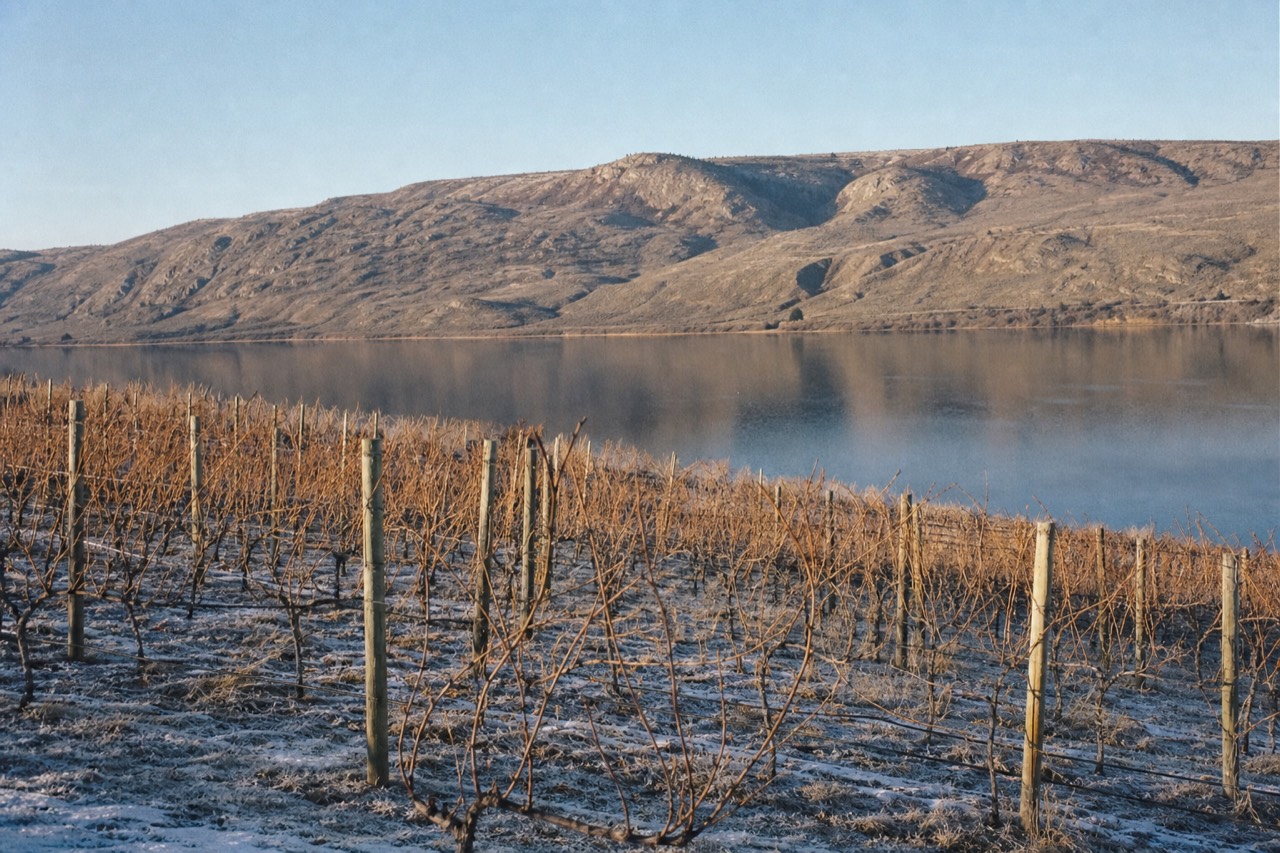
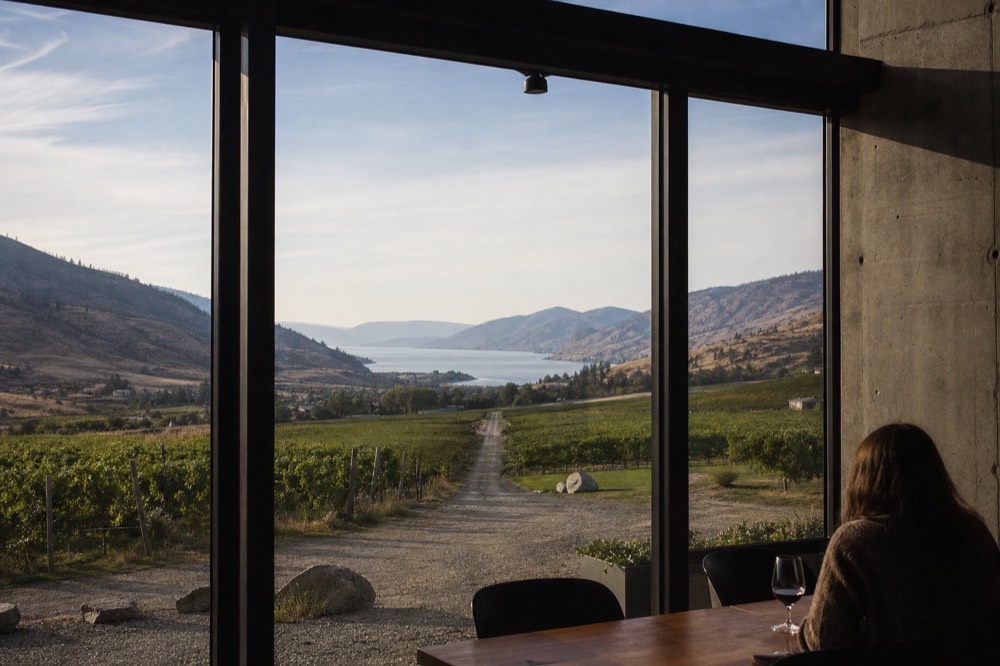
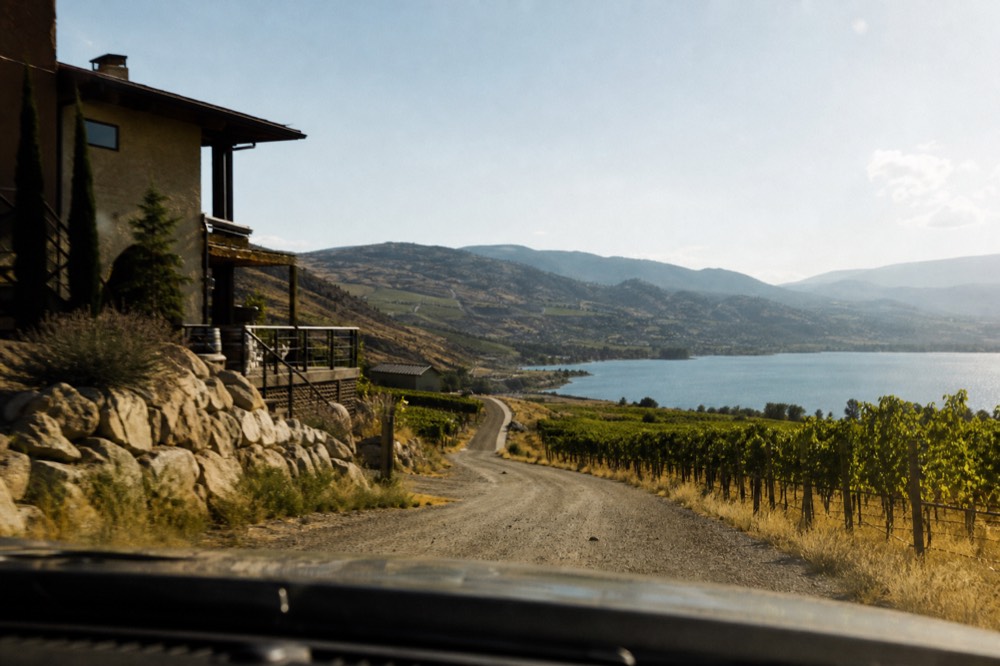
The drive south from Kelowna runs out of lake before it runs out of vineyard. Past Penticton the valley narrows, the hills go dry and pale, and by the time you reach Osoyoos the ground is genuine desert: pocket sand, cactus on the slopes, and the hottest growing conditions in the country. That heat is why the far south makes the Okanagan's biggest reds. It is also nearly two hours from Kelowna, and pretending otherwise would set up a bad day. So this guide does the honest thing and plans around the distance rather than around it.
Where is Osoyoos, and how far is it from Kelowna?
Osoyoos sits at the very bottom of the Okanagan Valley, hard against the United States border, about an hour and forty-seven minutes and 126 kilometres south of Kelowna. Oliver, its wine-country neighbour, is a little closer at around an hour and a half. That is a real haul each way, which is the single fact that shapes any Osoyoos wine plan.
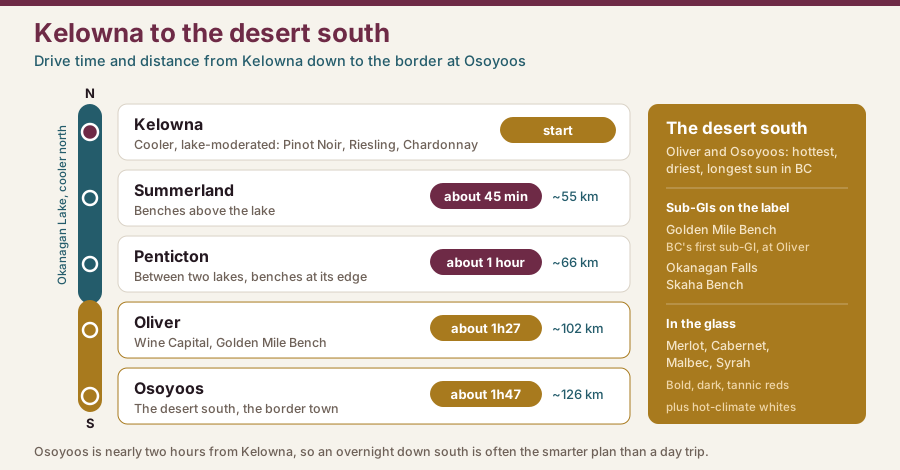
The distance is not a detail, it is the plan. Kelowna to Penticton is about an hour, Summerland around forty-five minutes, Oliver roughly an hour and twenty-seven, and Osoyoos the full hour and forty-seven. Add tasting stops and a lunch, and a day-return to Osoyoos from a Kelowna hotel becomes three and a half hours of driving wrapped around the wine. That works for some people and not for others, and it is worth deciding before you book anything. If the desert reds are the whole reason for the trip, the smarter move is often to base further south for a night. If Osoyoos is one stop on a bigger valley plan, the best Okanagan wineries by sub-region puts the geography in order from north to south.
The valley reads as one long corridor, and Osoyoos sits at the very bottom of it. Driving down from Kelowna you pass through the whole thing: the Westside and Naramata benches, Penticton wedged between its two lakes, Summerland's terraces, then Oliver's wine capital before the road finally reaches the desert town on the border. That is a lot of wine country to drive past on the way to more wine country, which is the real argument for breaking the trip up. Many visitors treat the south as its own two or three day loop rather than a day trip, tasting Oliver and Osoyoos from a bed down there and saving the Kelowna cellar doors for the start or end of the drive.
| From Kelowna to | Drive time (no traffic) | Distance | The place |
|---|---|---|---|
| Summerland | About 45 minutes | ~55 km | Benches above the lake |
| Penticton | About 1 hour | ~66 km | Between two lakes, benches at its edge |
| Oliver | About 1h27 | ~102 km | Wine Capital, Golden Mile Bench |
| Osoyoos | About 1h47 | ~126 km | Desert south, the border town |
What makes the Osoyoos and desert-south terroir different?
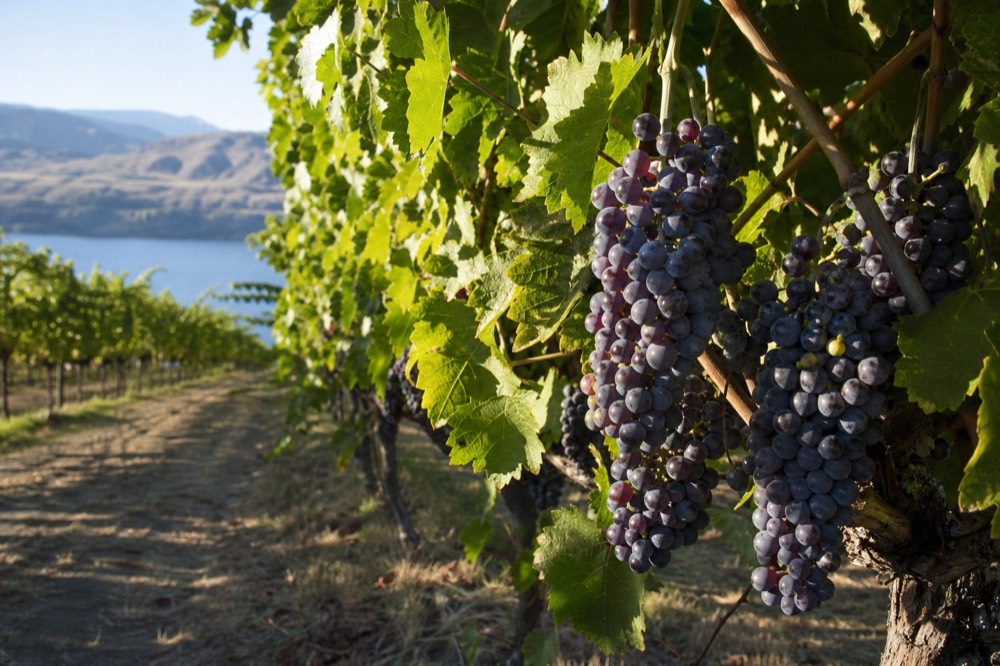
The south end is Canada's pocket desert: more heat, more sun, and sandy, well-draining soils that ripen big Bordeaux reds and Syrah the cooler north cannot always finish. Where Kelowna leans to Pinot Noir, Riesling and Chardonnay, Osoyoos and Oliver lean to Merlot, Cabernet, Malbec and Syrah, with real depth of colour and tannin.
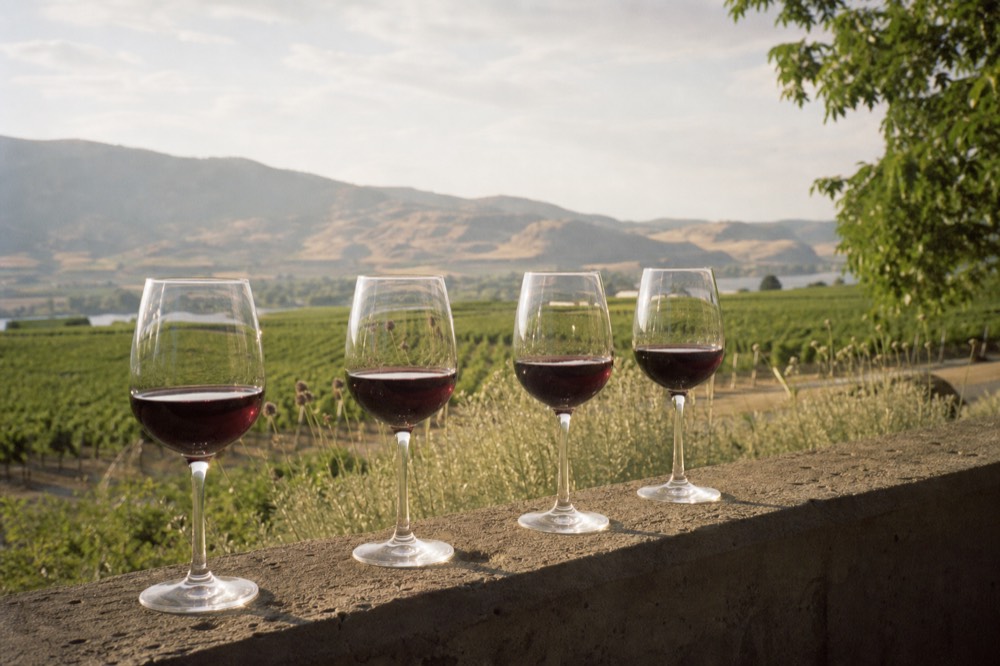
This is the payoff for the drive. The far south gets the longest, hottest days in the valley, and that extra ripening shows up as darker, fuller reds. The 2025 national wine awards read like a map of it: Burrowing Owl's 2021 Malbec and Painted Rock's 2022 Estate Grown Malbec both took Gold, Blasted Church and Hester Creek landed Golds for Cabernet Sauvignon, and Black Hills' 2023 Bona Fide won Platinum in the red-blends category. Those are wines that need heat, and the south is where the Okanagan finds it. The contrast with the cooler north is the reason to make the trip at all: a day tasting Osoyoos reds is a genuinely different glass from a day on the Kelowna slopes, and the grapes Kelowna is known for spells out the northern half of that split.
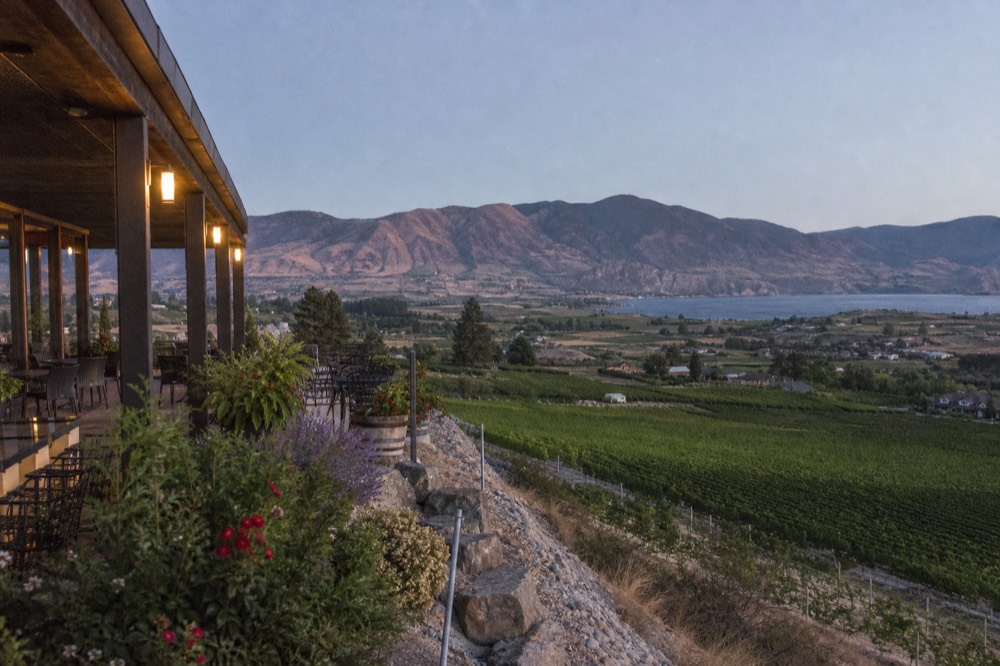
Osoyoos anchors the hottest corner of all. The town sits on Canada's only true pocket desert, where sagebrush, cactus and sand replace the orchard-green of the mid-valley, and Osoyoos Lake is one of the warmest freshwater lakes in the country. Those conditions ripen fruit that would struggle to finish further north, which is why the border stretch grew a reputation for muscular reds long before the sub-appellations were drawn. It is a landscape as much as a wine region, and the drive south is worth doing with the windows down at least once, if only to watch the valley turn from vineyard to genuine desert in the space of an hour.
| Trait | Desert south (Osoyoos, Oliver) | Cooler north (Kelowna, Lake Country) |
|---|---|---|
| Climate | Hottest, driest, longest sun | Cooler, lake-moderated |
| Signature grapes | Merlot, Cabernet, Malbec, Syrah | Pinot Noir, Riesling, Chardonnay |
| Soils | Sandy, gravelly, fast-draining | Glacial, varied, benchland |
| What is in the glass | Bold, dark, tannic reds | Bright whites, elegant Pinot |
Which South Okanagan wineries and sub-GIs define the desert south?
Two official sub-appellations anchor it. The Golden Mile Bench near Oliver, British Columbia's first sub-GI, runs east-facing slopes under Mount Kobau that suit Merlot, Cabernet Franc and Syrah, and Okanagan Falls just north leans to Chardonnay, Pinot Noir and sparkling. At Osoyoos itself, the Indigenous-owned Nk'Mip Cellars draws more than fifty thousand visitors a year in the desert.
The names cluster tight once you know the map. The Golden Mile Bench sits on gravelly, sandy loam between roughly 300 and 600 metres, and to put the sub-GI on a label a wine needs at least 95 percent of its grapes from inside those boundaries, which is why the appellation means something on a bottle. It was the first of British Columbia's official sub-appellations, joined since by Okanagan Falls, Skaha Bench and others down the valley. The producers behind the medals read as a who's who of the south: Burrowing Owl, Painted Rock on the Skaha Bench, Hester Creek, Blasted Church, Road 13, Black Hills. New arrivals keep coming too, from Domaine Artema on Oliver's Black Sage Bench to Oliver's Back Door Winery, which won approval in early 2026 for a 33 million dollar solar project over its vines. These cellar doors are spread across a wide southern spread, not a single walkable strip, so linking a few of them in a day takes a shaped route.
| Area | Status | Suits | Note |
|---|---|---|---|
| Golden Mile Bench (Oliver) | BC's first sub-GI | Merlot, Cab Franc, Syrah | East-facing slopes below Mount Kobau |
| Okanagan Falls | Official sub-GI | Chardonnay, Pinot Noir, sparkling | Cooler pocket north of Oliver |
| Skaha Bench | Official sub-GI | Bordeaux reds, Malbec | Painted Rock and neighbours |
| Osoyoos | Colloquial, desert south | Big reds, hot-climate whites | Nk'Mip and the border-town wineries |
The 2025 national wine awards are the cleanest shortlist of who is doing what down here, because the south swept the red categories that need real heat. Black Hills took the top Platinum in red blends, three separate producers landed Gold for Malbec, and the Cabernet Sauvignon class read almost entirely southern. If you are building a route and want a starting list, working from the medal winners is a sound way to do it, since these are wines a national panel rated blind rather than names a marketing team pushed.
| Winery | Wine | Recognition |
|---|---|---|
| Black Hills | 2023 Bona Fide | Platinum, Red Blends, 2025 nationals |
| Burrowing Owl | 2021 Malbec | Gold, Malbec, 2025 nationals |
| Painted Rock | 2022 Estate Grown Malbec | Gold, Malbec, 2025 nationals (Skaha Bench) |
| Blasted Church | 2022 Cabernet Sauvignon | Gold, Cabernet, 2025 nationals |
| Hester Creek | 2022 Cabernet Sauvignon | Gold, Cabernet, 2025 nationals |
| Gehringer Brothers | 2025 Dry Rock Unoaked Chardonnay | Best white, All-Canadian, 2026 |
To thread several of these southern names into a single day at your own pace, a private guide in your own vehicle is the tool that fits, since it can be pointed down the valley rather than tied to a fixed Kelowna loop.
How do you actually do an Osoyoos wine day from Kelowna?
Honestly, no featured tour here runs a dedicated Osoyoos cellar-door day. Two real options remain: base yourself around Oliver or Osoyoos for a night and taste the south locally, or take a private guide in your own vehicle and shape a southern route, with pickup available as far down the valley as Summerland and Penticton. From a Kelowna base, a full day stays around Kelowna and the Westside.
Here is the plain version. The Kelowna full-day tours, such as the day around Mission Hill and Quails' Gate, where you can see live dates and pricing, or the wider All Star route, are built on the Westside and Kelowna cellar doors, and they do not drive to Osoyoos. That is the base most first visits work from, and it is a good one for the north end of the valley. It is worth being clear-eyed about why: Osoyoos is nearly two hours each way, so a shared van day that promised the desert south and the Kelowna icons in one outing would spend most of its hours on the highway rather than at cellar doors. No honest full-day tour tries to do both, which is why the featured Kelowna days stay north and the southern trip is a separate plan.
For the south specifically, the flexible answer is a private own-vehicle day. You can build a route that heads down the valley and check current availability for the Okanagan private tour in your own vehicle, which is priced per group rather than per head and picks up as far south as Summerland and Penticton. If your heart is set on the desert reds, the cleaner plan is often to overnight nearer Oliver so the tasting is local rather than a two-hour commute. Either way, the driving decision matters as much down south as up north: a tasting flight is several pours, British Columbia's roadside limit is 0.05 with a warn range to 0.08 that triggers a driving ban, and long desert highways are not where you want to be doing that math. For the middle ground of Penticton and the benches at its edge, Penticton wine tours cover a base that is only an hour south.
| Way to do it | What it means | Honest fit |
|---|---|---|
| Kelowna full-day tour | Westside and Kelowna cellar doors | Does not reach Osoyoos; best for the north end |
| Private own-vehicle day | Choose-your-own route, per-group price | Shapes a southern run; pickup to Summerland and Penticton |
| Base south for a night | Stay near Oliver or Osoyoos | Best if the desert reds are the whole point |
| Self-drive with a sober driver | Your car, one person off the wine | Real option, but it is a long day of highway |
What does a South Okanagan wine day cost?
Budget the same broad ranges as the rest of the valley plus the fuel and time to get south. A shared Kelowna full day runs roughly C$180 to C$239 and up per person, a private own-vehicle day starts around C$180 per group for up to six, and tasting fees at the southern cellar doors typically run C$10 to C$25 each, often waived with a bottle.
The cost math has two moving parts down here. The first is the tour or the fuel, and the second is the tasting fees, which stack per winery. A shared full day out of Kelowna sits in the C$180 to C$239 band and covers the guide, the vehicle and usually lunch, though it keeps you in the north. A private own-vehicle day flips the pricing to per group, so four to six people sharing one booking often pay less per head than a shared van seat, from around C$180 per group with the current price on the operator's page. Add the southern distance and an overnight if you base down there, and the trip is less a half-day outing than a small road trip. For a full worked example of the numbers, what a Kelowna wine tour costs and Penticton tour pricing both lay out where the dollars go.
| Cost piece | Typical CAD | Note |
|---|---|---|
| Shared full day from Kelowna | Around C$180 to C$239+ pp | Stays around Kelowna and the Westside |
| Private own-vehicle day | From around C$180 per group | Up to six, per-group pricing, southern route possible |
| Southern tasting fees | Around C$10 to C$25 pp | Often waived with a bottle purchase |
| An overnight down south | On top | Frequently the smarter plan for Osoyoos itself |
For a wider Kelowna-and-Westside full day at a set per-person price, the All Star route is the comparison point against a private southern build.
When should you go, and what is on in the desert south?
September and October are the sweet spot: harvest is on, the desert heat has eased to the low twenties, and the crowds thin from the July and August peak. The south's big date is Oliver's Wine Capital Weekend, listed for September 18 to 20, 2026, with the Festival of the Grape, more than 40 wineries and the Grape Stomp.
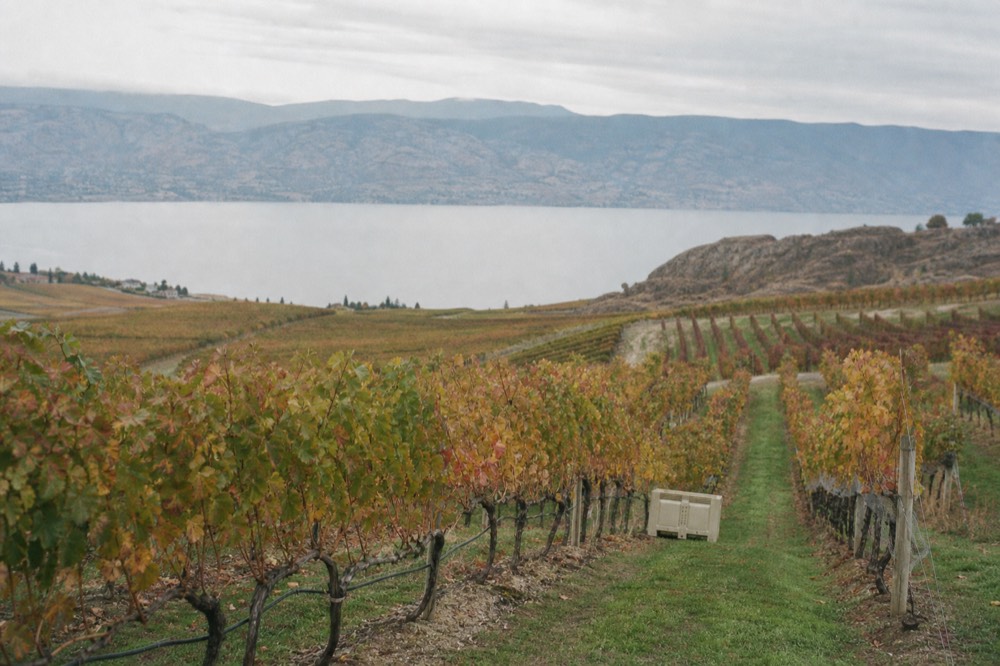
Timing rewards the patient. High summer in the desert south is genuinely hot, which is glorious for the vines and hard on a full day of tasting, so many visitors prefer the shoulder of early fall when harvest colour is on the slopes and the temperature sits nearer 20 to 28 degrees. That window also lines up with the region's marquee event: Oliver bills itself as the wine capital, and its September weekend pulls in dozens of southern wineries for the Festival of the Grape. Winter is the quiet season down here, with reduced hours and seasonal closures from November into spring, so a cold-month plan needs a call ahead. Across the valley, the wider Okanagan touring guide sets out the seasons and the festival calendar in full, and Summerland's benches make an easier southern stop than Osoyoos if the distance is the sticking point.
The Wine Capital Weekend is the date to build a southern trip around if you can. Listed for September 18 to 20, 2026, it centres on the Festival of the Grape with more than 40 wineries pouring, plus the Grape Stomp, a Cask and Keg tasting and a kick-off concert, all timed to the start of harvest. Book accommodation early for that weekend, because Oliver and Osoyoos are small towns and the beds fill fast. Even outside the festival, early fall is when the whole desert south is at its best: the heat has broken, the crush is on, and the cellar doors are lively without the July crowds. If you can only make the trip once, that is the window to aim for.
| Season | The desert south | Good for |
|---|---|---|
| September to October | Harvest, easing heat, thinner crowds | The best all-round window; Wine Capital Weekend |
| July to August | Hottest and busiest | Long days, but heavy heat for full-day tasting |
| May to June | Warming shoulder | Value and space before the peak |
| November to March | Quiet, reduced hours | Check ahead; many rooms close |
Common questions
Is there a wine tour from Kelowna to Osoyoos?
Not as a dedicated featured day. The Kelowna tours stay around the Westside and Kelowna cellar doors. To reach Osoyoos, the honest routes are a private guide in your own vehicle, shaping a southern run, or basing yourself nearer Oliver or Osoyoos for a night and tasting the desert south locally.
How far is Osoyoos from Kelowna?
About an hour and forty-seven minutes and 126 kilometres, at the very bottom of the Okanagan Valley on the United States border. Oliver, the neighbouring wine town, is a little closer at roughly an hour and a half. A day-return from Kelowna means around three and a half hours of driving wrapped around the tasting.
What wine is Osoyoos known for?
Big, dark reds. The desert south is the hottest, sunniest part of the valley, which ripens Merlot, Cabernet, Malbec and Syrah with real depth. Southern producers led the 2025 national awards in the red categories, and the Golden Mile Bench near Oliver is the region's flagship sub-appellation.
Should you base in Osoyoos or day-trip from Kelowna?
If the desert reds are the main event, base south for a night so the tasting is local instead of a two-hour commute each way. If Osoyoos is one stop in a bigger valley plan, a private own-vehicle day can shape a southern route, and Penticton at one hour makes an easier halfway base.
What is the Golden Mile Bench?
It is British Columbia's first official wine sub-appellation, a run of east-facing slopes near Oliver below Mount Kobau. The gravelly, sandy soils and moderate microclimate suit Merlot, Cabernet Franc and Syrah. To carry the Golden Mile Bench name, a wine needs at least 95 percent of its grapes from inside the defined boundary, so the label means something specific.
Is Osoyoos too far for wine tasting from Kelowna?
Not too far, but far enough that it changes the plan. At nearly two hours each way, a day return leaves limited time at cellar doors once you add lunch and tasting stops. If the southern reds are your goal, most people find an overnight nearer Oliver or Osoyoos makes for a far better day than the round-trip drive allows.
What is Nk'Mip Cellars?
Nk'Mip Cellars is the Indigenous-owned winery at Osoyoos, on the desert land at the far south of the valley, and it draws more than fifty thousand visitors a year. It is the best-known name in the border town and a natural anchor for a southern route, sitting among the hot-climate reds and whites that define the Osoyoos end of the Okanagan.
The desert south is worth the distance, but only if you plan for the distance, which is exactly the kind of route Kelowna Wine Tours helps a group build so nobody spends the drive home counting the pours they had at lunch. Decide whether you are basing south or shaping a private day, and the far end of the valley opens up.